
Answering those little conundrums that fascinate and confuse us about this extraordinary Comic Book series.
Within this page you will find explanations to some common terms used in describing various issues. For instance, what is meant by HRN? When is a CI an original edition? What do we mean by LDC and PCV? Some visitors to the site may know all of this but for those new collectors I hope these explanations prove to be helpful.
Question 1: What is meant by the Highest Re-order Number (HRN) on the Classics Illustrated series?
Answer: The HRN is more often than not found on the back of the comic. On the back (or sometimes inside the front or back covers) you will usually find a list of the other Classics Illustrated titles that were in print when the comic that you are looking at was printed. This list can go up to number 169 – Negro Americans: the Early Years, which was the last CI ever published. Thus, if you had a comic which had that title as the last one listed, the HRN on that comic would be 169. Common HRNs include 126 – The Downfall and 129 – Davy Crockett (in the British series) and 167 – Faust in the US series. It merely provides the collector with an idea of what version he or she is buying and how old the comic is. Some of the titles were reprinted over a dozen times and the HRN allows us to ascertain what reprint run a particular issue was part of. For more help identifying an issue, see our reference guides.
Question 2: What is the difference between the different editions of each of the Classics Illustrated series?
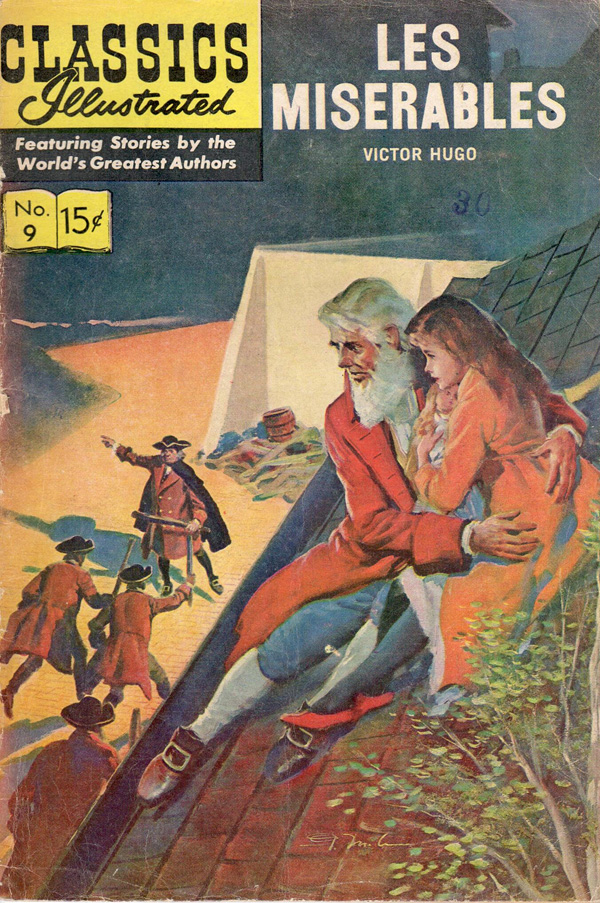
Answer: In the main the editions are pretty much the same as each other. The original edition is distinctive (see Question 4 below) and at certain different editions the cover would change from Line Drawn (LDC) to Painted (PCV) and sometimes then to a second Painted cover (PCV2) (see Question 3). Also, at certain editions, new interior artwork would be introduced (see Question 5).
Question 3: What is the difference between a Line-Drawn Cover (LDC) and a Painted Cover version (PCV) on the CI series?
Answer: Initially, Gilberton, the American publishers of Classics Illustrated, published the comic with a rather basic and “cartoonish” cover drawing. This is known as the Line-Drawn Cover or LDC. On later issues however, whilst most of the inner artwork would remain the same (with some exceptions) a Painted Cover version (PCV) would replace the Line-Drawn Cover. It is the painted covers that we probably all remember most, but, because they were produced earlier, it is the Line-Drawn versions that cost more and grow in value more quickly. Later, Gilberton would re-issue some titles with a second Painted Cover (PCV2) and these are very sought after because, with one or two exceptions, they were not produced in the UK. Some of the titles in the US series were only ever printed in the Line-Drawn format (for instance, Great Expectations) but the UK publishers produced a Painted Cover of them and these British editions are very sought after.
 |
 |
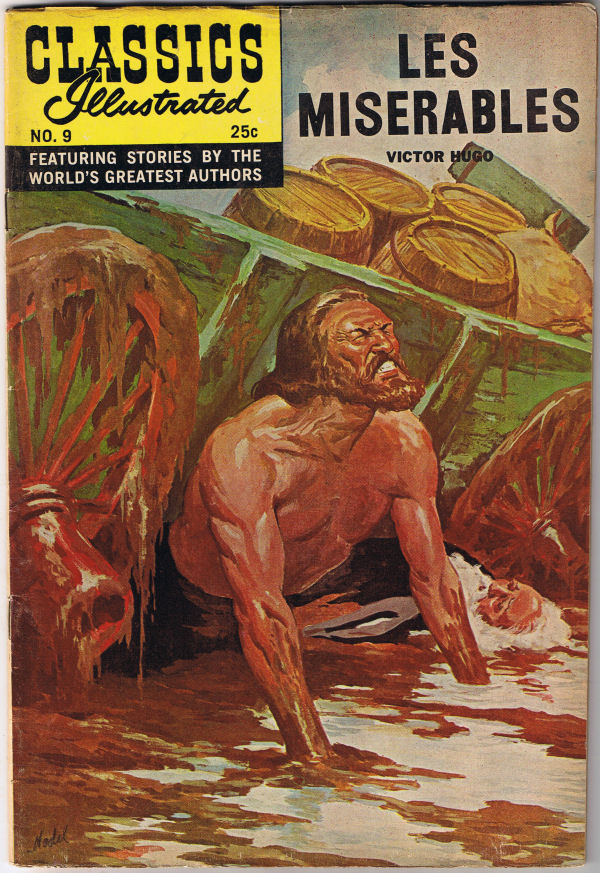 |
| Line-Drawn Cover | First Painted Cover | Second Painted Cover |
Question 4: What is meant by an Original issue of a CI?
Answer: Many collectors are keen to collect original editions. These cost more and more are sought after and appreciate in value more quickly. An original edition will normally have a HRN that is the one before its own issue number. So the HRN on no. 56, The Toilers of The Sea, will be no. 55 – Silas Marner. Original issues are also identifiable because they have an advert inside the front or back cover of the next title that is to be published – in The Toilers of the Sea this is no. 57 – The Song of Hiawatha. We mention Toilers as an example here because we believe it was the first Classics Illustrated to sell for in excess of $1000 in 2001! That was an Original in flawless, virtually mint condition. So Originals are like a first edition of a book and attract a premium in the same way.
Question 5: Many of the Classics Illustrated series had new interior artwork drawn – how can I tell which is which?
Answer: You may want to purchase one of the reference guides for sale to study the series fully including the different artists (where known) for both covers and interiors. However the list below outlines the interior artwork changes (all other editions had only one interior artwork):
The Three Musketeers had new interior artwork from edition 15
Ivanhoe had new interior artwork from edition 14
The Count of Monte Cristo had new interior artwork from edition 14
The Last of the Mohicans had new interior artwork from edition 15
Moby Dick had new interior artwork from edition 14
A Tale of Two Cities had new interior artwork from edition 11
Robin Hood had new interior artwork from edition 14
Arabian Nights had new interior artwork from edition 8
Les Miserables had new interior artwork from edition 9
Robinson Crusoe had new interior artwork from edition 12
Rip Van Winkle had new interior artwork from edition 12
Dr Jekyll and Mr Hyde had new interior artwork from edition 9
Uncle Tom’s Cabin has only the one interior artwork
The Hunchback of Notre Dame had new interior artwork from edition 13
Huckleberry Finn had new interior artwork from edition 11
Oliver Twist had new interior artwork from edition 12
A Connecticut Yankee in King Arthur’s Court had new interior artwork from edition 8
The Last Days of Pompeii had new interior artwork from edition 2
Typee had new interior artwork for one of the UK editions and numbered 116 – this interior artwork was not produced in any of the US issues
The Adventures of Cellini had new interior artwork from edition 2
Jane Eyre had new interior artwork from edition 9
Swiss Family Robinson had new interior artwork from edition 9
Tom Brown’s School Days had new interior artwork from edition 3
The Adventures of Tom Sawyer had new interior artwork from edition 11
The House of the Seven Gables had new interior artwork from edition 4
The Man in the Iron Mask had new interior artwork from edition 4
The Toilers of the Sea had new interior artwork from edition 2
Black Beauty had new interior artwork from edition 4
The Man Without a Country had new interior artwork from edition 4
Julius Caesar had new interior artwork from edition 5
The Man Who Laughs had new interior artwork from edition 2
The Jungle Book had new interior artwork from edition 12
The Gold Bug had new interior artwork for one of the UK editions – this interior artwork was not produced in any of the US issues
The First Men in the Moon had new interior artwork from edition 6
Question 6: What is meant by a Stiff Cover Version?
Answer: After Patrick Frawley bought the rights to publish these comics from Albert Kanter (see CI History page) he printed many of the series with a stiff card cover – these aren’t hardbacks but the covers are heavier than the old glossy paper covers and wears better as a result. These were printed in the late sixties before Frawley gave up on the series in 1970.
Question 7: What is the difference between a US issue and a British issue (beyond the difference in currency as a price)?
Answer: The British issues were generally printed on better paper than in the US and with better, more vibrant inks – consequently they have more appeal on the eye but they cost a bit more since less were printed over here. If you did have these as a child, however, you are likely to have had some of both since many US issues were shipped over here and a shillings and pence price sticker affixed over the cents price.
Question 8: What titles were printed in the US series and not printed in the British series?
Answer: There were fifteen titles published in the US series that were never published in the British series:
21 – Three Famous Mysteries (featuring Arthur Conan Doyle’s The Sign of the Four, Guy de Maupassant’s The Flayed Hand and Edgar Allan Poe’s The Murders in the Rue Morgue)
26 – Frankenstein (Mary Shelley)
33 – The Adventures of Sherlock Holmes (Arthur Conan Doyle)
44 – Mysteries of Paris (Eugène Sue)
66 – The Cloister and the Hearth (Charles Reade)
76 – The Prisoner of Zenda (Anthony Hope)
83 – The Jungle Book (Rudyard Kipling)
92 – The Courtship of Miles Standish and Evangeline (Henry Wadsworth Longfellow)
95 – All Quiet on the Western Front (Erich Maria Remarque)
102 – The White Company (Arthur Conan Doyle)
110 – A Study in Scarlet (Arthur Conan Doyle)
117 – Captains Courageous (Rudyard Kipling)
136 – Lord Jim (Joseph Conrad)
143 – Kim (Rudyard Kipling)
169 – Negro Americans: The Early Years
Question 9: What titles were printed in the British series and not in the US series?
Answer: There were thirteen titles published in the British series that were never published in the US series:
143 – Sail with the Devil (Daniel Defoe)
146 – Adventures of Baron Munchausen (Rudolf Erich Raspe)
147 – Through the Looking-Glass (Lewis Carroll)
148 – Nights of Terror (featuring Wilkie Collins’ A Terribly Strange Bed and Charles Dickens’ The Signalman)
149 – The Gorilla Hunters (R. M. Ballantyne)
150 – The Canterville Ghost (Oscar Wilde)
156 – The Dog Crusoe (R. M. Ballantyne)
157 – The Queen of Spades (Alexander Pushkin)
158a – Doctor No (Ian Fleming – perhaps the most valuable CI to be had today)
159 – Master and Man (Leo Tolstoy)
161 – The Aeneid (Virgil)
162 – Saga of the North (Pierre Loti)
163 – The Argonauts (Apollonius of Rhodes)